Showing posts with label 19th century. Show all posts

Monday, March 3, 2014

what I did on my holidays (part the third)

On my final full day in England, I got up and drove to Winchester, Hampshire.

This is not my own photo, because for some reason I didn't take one from outside of the cathedral which is basically the central point of Winchester:

Image via Panoramio
 It didn't really look like that on the day, being December in the northern hemisphere, and in England no less - but it did look rather beautiful.  It happened to be a day of Christmas markets!


Christmas markets are a happy thing.

What I was really there to see, though, was the interior.
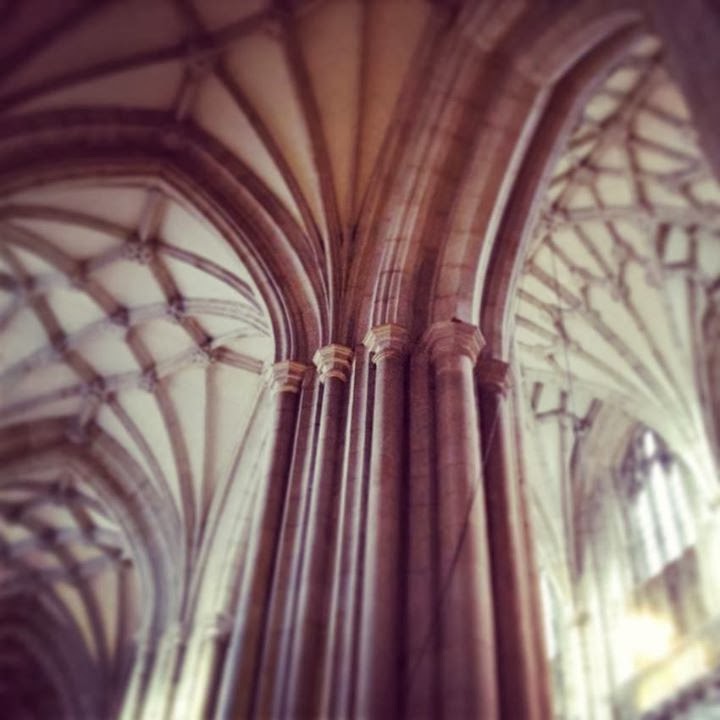
Winchester Cathedral
 In particular...


The slightly weird thing about visiting Jane Austen's grave is that it's just another slab in the floor which you're clearly not expected to refrain from walking over.  In this photo, you can even see the leg of one of the cathedral chairs placed artistically (or maybe not so artistically) over the gravestone.

Never mind.  Here was the gravestone, and I am thankful that it still exists, unlike so many of the things which used to prove she existed and now are gone forever.  Actually, the more I think about it, the more I think we are extremely lucky to have as much as this grave, because she certainly wasn't drastically famous when she died, and we probably owe our luck to the fact that she had a rich brother.

It wasn't until later that they installed a stained glass window for her in the same cathedral (of which I got no good photos), and this gold thing:


From Winchester, it was off to the tiny town of Chawton, where Jane Austen lived for the last eight years of her life.  This house was a part of her rich brother's estate - he had been adopted by his aunt and uncle when he was small, as they could have no children of their own, and his own parents recognised it was a good opportunity for him.  In fact, his riches meant that Jane, her sister Cassandra and her mother did not have to have a drastic lifestyle change after the death of her father.

The Austen women and a family friend, also a single woman, lived in this red brick house in Chawton:


Jane used to sit in the parlour, writing at this very table, and hiding her sheets of paper under a blotter when people entered for visits:


This was the place she edited Pride and Prejudice, Sense and Sensibility and Northanger Abbey before they were published.  This was the place she wrote Emma, Mansfield Park and Persuasion.

She and Cassandra shared a room upstairs, looking out over the back of the house:


It was absolutely lovely to visit this place.  They had a few items of real interest, like the writing desk, although most items were objects of a similar kind to what the Austen family might have had in their home.  Walking round someone's house, though, you get a sense of the way they lived, and can visualise their lifestyle in a new and interesting way...  I found it quite moving and I also found myself thinking extremely conceited thoughts like "We would have been best friends!"  Slightly wishful thinking but that was the direction my thoughts went in.

This really was a wonderful note to finish my time in England on.  (If I were being really honest I would admit that I actually finished my time in England in the nearby town of Basingstoke and then flew out of London Stansted, neither of which is in any way romantic or exciting, but I'm going to pretend I ceased to be in England when I left Chawton.)

Saturday, February 22, 2014

what I did on my holidays (part the second)

Bristol
After visiting Bath, I had a non-Austen interlude in Bristol, visiting my old penpal and former fellow HDtS editor V. - which was lovely.  The last time we saw each other we were 11 years old!

Somewhere in Somerset

After two nights with V. and her husband M., I hired a little red ladybug-like car and set off on the next stage of my literary pilgrimage.  To be honest, the first stage of this next stage was not-so-literary - I was simply driving through Somerset, on the way to my ultimate literary destination, and stopping at Wells to see a pretty cathedral town.  And a pretty cathedral town it was:

Wells
After wandering round Wells and scoffing a Cornish pasty, I was on the move again - driving into Dorset on my way to the coastal town of Lyme Regis.

Lyme Regis
Lyme Regis is a gorgeous little seaside town on the Jurassic Coast of southern England, and it happens to be a place where the Austen family spent some holidays.  Jane Austen loved the place, and she ended up using it for the location of a pivotal part of Persuasion.  (Interestingly enough, I understand it's also the location for a Meryl Streep movie, the title of which I cannot remember...)


Even if I weren't a Jane Austen fan, I would have loved visiting this place.  Little English seaside towns have such an atmosphere, and this one is completely charming.

But it certainly added something, knowing that I was walking around a place that Jane Austen loved, and, especially as I approached the Cobb, visualising her characters taking the very same path as me.

The Cobb


The Cobb is a kind of breakwater to the west of the village which creates an artificial harbour - boats can be moored within it while the waves beat on the other side.  I had no idea until now just how old it is - the first written record is from 1328.

You can walk along the top, and risk getting splashed, or down out of the wind and seaspray.  I walked on the top, and I can understand now exactly why Louisa Musgrove started getting over-excited.


... as they drew near the Cobb, there was such a general wish to walk along it once more, all were so inclined, and Louisa soon grew so determined, that the difference of a quarter of an hour, it was found, would be no difference at all; so with all the kind leave-taking, and all the kind interchange of invitations and promises which may be imagined, they parted from Captain and Mrs. Harville at their own door, and still accompanied by Captain Benwick, who seemed to cling to them to the last, proceeded to make the proper adieus to the Cobb. ...

The steps of the Cobb
There was too much wind to make the high part of the new Cobb pleasant for the ladies, and they agreed to get down the steps to the lower, and all were contented to pass quietly and carefully down the steep flight, excepting Louisa: she must be jumped down them by Captain Wentworth. In all their walks he had had to jump her from the stiles; the sensation was delightful to her. The hardness of the pavement for her feet made him less willing upon the present occasion; he did it, however. She was safely down, and instantly to shew her enjoyment, ran up the steps to be jumped down again. He advised her against it, thought the jar too great; but no, he reasoned and talked in vain, she smiled and said, "I am determined I will": he put out his hands; she was too precipitate by half a second, she fell on the pavement on the Lower Cobb, and was taken up lifeless! There was no wound, no blood, no visible bruise; but her eyes were closed, she breathed not, her face was like death. The horror of that moment to all who stood around!

Captain Wentworth, who had caught her up, knelt with her in his arms, looking on her with a face as pallid as her own, in an agony of silence. "She is dead! she is dead!" screamed Mary, catching hold of her husband, and contributing with his own horror to make him immoveable; and in another moment, Henrietta, sinking under the conviction, lost her senses too, and would have fallen on the steps, but for Captain Benwick and Anne, who caught and supported her between them.

"Is there no one to help me?" were the first words which burst from Captain Wentworth, in a tone of despair, and as if all his own strength were gone. 

"Go to him, go to him," cried Anne, "for heaven's sake go to him. I can support her myself. Leave me, and go to him. Rub her hands, rub her temples; here are salts: take them, take them."

Captain Benwick obeyed, and Charles at the same moment disengaging himself from his wife, they were both with him; and Louisa was raised up and supported more firmly between them, and everything was done that Anne had prompted, but in vain; while Captain Wentworth, staggering against the wall for his support, exclaimed in the bitterest agony --
   
"Oh God! her father and mother!"
   
"A surgeon!" said Anne.


I couldn't stop smiling as I walked up and down the Cobb and particularly as I carefully made my way down the steps.  This is my happy place.

And that was the end of the second day of my pilgrimage.

Sort of.  I then drove to a tiny little place called Durweston, Blandford Forum, Dorset - which I think is just a wonderful series of names - and stayed the night in a thatched cottage.  I would name this day as one of the best days of my whole trip.

Monday, February 17, 2014

"rescuing" jane eyre

I have to confess that when I first saw this story on the BBC News website I was appalled.

"Is Jane Eyre a feminist icon?" the headline asked.  Then the text read 'The writer Beatrix Campbell praised the new production for aiming to "rescue" the book from becoming "a late 20th century Fifty Shades of Grey" in which "a poor girl meets a rich brute and falls for him".'

I was totally appalled because I couldn't believe anyone would try to "rescue" the book or question the feminist significance of it.

Then I listened to the podcast and realised I had got muddled - it's actually about rescuing Jane Eyre from the MODERN interpretation of the book, which emphasises the passionate love story over  Jane's character, grit and resilience.  Instead, the play they are talking about is a life story, not a love story - like the book.

Have a listen.  It's good stuff.

It reminds me of an article I read on Jane Eyre the film, by a certain male film critic who decided the film adaptation supported his idea that Jane Eyre is no feminist role model.  Interesting, given the comments above.

Anyway, what I remember about the article is not this critic's nebulous reasoning.  It's a comment that someone wrote underneath it which I've always been quite pleased by.  I think pleased because someone else had put into words my own feelings about the book, feelings that I had never expressed half as well.  Jane Eyre is a novel that tends to bring out different reactions in everybody who reads it, and so it's rare to find that someone else feels the same way.  You may feel completely differently and be disappointed or slightly sceptical about the below, but here is the comment:


Thursday, February 13, 2014

what I did on my holidays (part the first)

Pulteney Bridge


I did a lot of things on my holidays.  They were six weeks long and I visited Europe, in fact.  But one of my favourite things of all was my Jane Austen pilgrimage.

Part 1 of the pilgrimage was in Bath, England, where Jane Austen spent some years of her life and where parts of her novels Northanger Abbey and Persuasion are set.  It happens to be somewhere she hated to live - it is said that she fainted when she learned that her parents were leaving the family parsonage in Steventon, Hampshire, and taking Jane and her sister Cassandra to live in Bath.  When she wrote Northanger Abbey as a younger woman the bright lights were still an exciting prospect for her, but by the time she wrote Persuasion as an older woman she had well and truly tired of Bath and what I understand she considered to be its shallowness.  While she lived there, she found herself unable to write successfully at all.  It was not until she left Bath and moved to the small village of Chawton, onto her brother's estate, that her most productive era began.

There is a bit of a Jane Austen industry in Bath - it is home to the Jane Austen Centre, and its heyday was Georgian, so it really does look the part.  I even found a free audio tour online, with a complementary map, to take you around "Jane Austen's Bath".  In fact, it's a collection of places that are directly relevant to Jane Austen and her novels, and then a bundle of other places that just look like Regency fiction (or may have been scenes in different movie adaptations).

Having said that, despite all the Georgian England overtones, I wandered into a random café at one point, sat down and realised I was sitting next to a Rolling Stone (Ronnie Wood, to be precise, looking slightly out of place).  Luckily, at 27 years old, I'm not young enough to interest him, but for those out there who may not be fans of Jane Austen, there are other reasons to visit Bath.

Anyway - back to the tour - I will take you through a few of its moments.

The Pump Room
First up, the Pump Room.  I have to admit I only popped my head in here because it was a particularly beautiful tearoom/café (maitre d', live pianist, crisp linen and all that) and I didn't feel like paying to eat more food and having to mind my manners instead of pulling my book out and leaning on my elbows on the table.  But while I hovered at the entrance, I took a deep breath, assessed the room, blotted out all the modern-day tourists and elderly couples drinking tea and eating scones - and imagined women in Empire-waisted dresses - circulating.  It was a successful imagining.

Laura Place
I got quite excited when I arrived at Laura Place - a square which was very desirable in early 19th century England - and which I imagine is probably still pretty desirable today.  "Our cousins the Dalrymples" lived there: that is, the Dowager Viscountess Dalrymple and the Honourable Miss Carteret of Persuasion, the noble, rich but meaningless cousins courted by Anne Elliot's father and sister.

Jane Austen's noble residence
Soon after walking a little further down Great Pulteney Street, I turned onto Sydney Place, which is a little more plebeian than Laura Place and Great Pulteney Street, and happens to be where Jane Austen resided while in Bath - until her father sadly died, and her family could no longer afford to live there.

Like any great site in Europe, it was covered in scaffolding.  (I can only assume it is due to its greatness and to my tendency for bad luck?)
Royal Crescent
Royal Crescent bears no real connection with Jane Austen except that it is a very lovely and reasonably regal-looking street which appears in a number of Austen adaptations for the screen.  I'm okay with that - it was definitely worth seeing.

Shortly before arriving at Royal Crescent, I walked down:

Gravel Walk
'Gravel Walk.'  As I walked I listened to the audioguide, and this is where I really felt the audio was a great idea.  It was quite an experience to listen to the following as I walked - the happy reconciliation  of two loved, deserving characters in my favourite book:

Soon words enough had passed between them to decide their direction towards the comparatively quiet and retired gravel walk, where the power of conversation would make the present hour a blessing indeed, and prepare for it all the immortality which the happiest recollections of their own future lives could bestow. There they exchanged again those feelings and those promises which had once before seemed to secure everything, but which had been followed by so many, many years of division and estrangement. There they returned again into the past, more exquisitely happy, perhaps, in their reunion, than when it had been first projected; more tender, more tried, more fixed in a knowledge of each other's character, truth, and attachment; more equal to act, more justified in acting. And there, as they slowly paced the gradual ascent, heedless of every group around them, seeing neither sauntering politicians, bustling house-keepers, flirting girls, nor nurserymaids and children, they could indulge in those retrospections and acknowledgments, and especially in those explanations of what had directly preceded the present moment, which were so poignant and so ceaseless in interest. All the little variations of the last week were gone through; and of yesterday and to-day there could scarcely be an end.

Gravel Walk must be a very different place than it was then, but it's still there, and it was a lovely feeling to me to know that Jane Austen had wandered along the same walk, and sent her own characters there for such a moment in their lives.

Disappointments:
  • The Jane Austen Centre - It's really set up for people who just looooove Mr Darcy and his wet shirt.  I'm not knocking the shirt.  I just wanted to learn something.  I did, however, buy a cool graphic novel version of Pride and Prejudice in the shop.
  • The Assembly Rooms - They were closed for a function.  Whaaaat?!  I had been really looking forward to wandering around pretending to be Catherine Morland.

Thursday, April 28, 2011

listening in to Emma Woodhouse

A little while ago, I bought a cheap audiobook of Jane Austen's Emma on iTunes. And then, this week, I happened to be doing a lot of painstaking, long-lasting but completely mindless activities - knitting a scarf, painting decorations for my upcoming singalong Chitty Chitty Bang Bang party, lots of baking, going for walks, etc. It seemed like perfect timing to pull out an audiobook and listen as I worked.

I make it a point not to read Jane Austen novels too often because I love them so much and get such a pure enjoyment out of them that I don't want to risk becoming used to them. So it's actually been quite a long time since I read Emma, and I've only read it about twice, maybe three times at most. And I found myself rediscovering the book with great pleasure.

I really think it's such a wonderfully-structured novel. It's one of those novels which is very exciting as you read it for the first time, because the plot unfolds with so many little and large surprises. However, I discovered that it's just as wonderful to read a second time - Austen has packed it full of little road signs and ironies that all point towards the ultimate denouement, and these are so enjoyable to pick up on that knowing what is about to happen becomes a positive thing! I also love the skill with which Austen gives us a hidden love story, a love story in the background which is unseen by all the characters and all first-time readers but which becomes clear after the first reading. It is rather a touching love story.

Reading Emma this time around, I think I may have matured a little, because I found Austen's portrayal of Miss Woodhouse very satisfying. Last time, I was probably disappointed by the lasting imperfections of her character. This time, I loved how the narrator is so unreliable, and how Emma is so flawed, and how the narrator never judges Emma. She simply lays out this character who is as charming and well-meaning as she is mischievous/prideful/arrogant. She gives us a character who is lovable despite her faults and even because of her faults. Even towards the end, Austen doesn't fall prey to the temptation to completely rehabilitate her main character. The novel is a journey of self-discovery, and yet it's not over at the end, and she's still not perfect. There's a delicious irony to the fact that Emma feels so exposed to herself and yet there is still so much she is unaware of.

This is characterisation that precludes academic mangling. It resists a Marxist reading, a feminist reading, and many other kinds of readings - it's much more complicated.

Of course, we are given all the wonderful minor characters, a hallmark of Austen novels. Mrs Elton is deliciously awful. Miss Bates is so lovely and yet so painfully familiar to all of us. Mr Woodhouse such a nice, narrow-minded old invalid.

It is rather a long book. Reading it as an audiobook helped a little because I could not skim the longest episodes but had to listen to the whole - and this was definitely worth doing. I loved it. I feel a little sad at the prospect of doing mindless tasks without Jane Austen, now. Four and a half stars. No surprise, given my love for Austen, but I am trying to be unbiased and objective!!

Friday, February 11, 2011

playing with dolls of a fictional sort

I did something very silly yesterday.

I was bored. The essential prerequisite.

I went on facebook and nothing, absolutely nothing, was happening. Sometimes, in situations like this particular one, I feel like yelling, with virtual hands raised to the sky, "O facebook! ENTERTAIN ME!"

Here is what happened next. I created a new facebook account for Jane Austen.

Obviously, I am not the first person to have wasted time in precisely this way. But I still feel slightly embarrassed about the enjoyment I got out of listing her hometown, her final resting place, the languages she speaks, the school she went to (which, fantastically enough, still exists)...

Jane Austen (aka, Me) now "likes" Fanny Burney, Ann Radcliffe, and her own novels. She "likes" playing the piano. Burney, Radcliffe, Bram Stoker, William Makepeace Thackeray and so on have not yet accepted her friendship requests. I left out Charlotte Brontë on purpose, given her less than admiring comments about Miss Austen.

I don't know enough about her to know who/what else I should add. But doing some research on this should be fun!

Am still in two minds about posting this for all to see on the blog. It seems just a little too embarrassing...

Thursday, December 30, 2010

the woman in white


I have recently finished Wilkie Collins' The Woman in White, which was published in 1860. It's been my summer-days-lying-in-a-hammock-while-celebrating-Christmas novel. I would definitely recommend it for this type of reading - it's gripping, and rather fun, and definitely not a difficult read at all. I expected it to be about ghosts and was pleased it was a novel of detection instead.

Having said that, there were moments in which I could not contain my frustration with the author. Marian Halcombe could have been a fantastic heroine if we weren't constantly reminded how "unwomanly" she is. The section narrated by her is wonderful, but we hear no more directly from her after that, even when she is still taking an active role - a huge pity. Laura Fairlie could have been much more interesting if she wasn't so utterly helpless, although of course she needed to be insipidly fragile in order to inspire love and devotion (about which I think my last blog post complained). I feel that this tale could have been much more subversive than it actually was. The situation in which Laura finds herself is so entirely wrong. She is a casualty of a world that is run by men for men, but the author hardly questions the society that allows this to happen. Of course, he was a man himself, but that shouldn't have to mean he props up societal conventions even as he shows their flaws.

The big unexpected twist in the middle of the novel (I don't want to spoil it so I can't expand) is a relief, but after that I expected many more unlikely things which did not happen. The number of coincidences applied to the story (such as the importance of Professor Pesca at the end) also seem a little too much. The villains did not ring quite true to me. Then, the plot, which had promised so much at the beginning, began to lose momentum.

All the same, I did enjoy this novel. It has a spark of something. It made me want to keep reading, even when I could see all its flaws. It's a fun book! It slides between the different narrators reasonably fluidly, it pulls out the absurdities of characters and laughs at them, it doesn't take itself too seriously. It does manage to create a very appealing character in Marian Halcombe - I only wish she could speak for herself a little more. Maybe someone should write some fanfiction!!

I give it three stars. It is a good book, it is a fun book, but it is flawed.