Showing posts with label austen. Show all posts

Monday, March 3, 2014

what I did on my holidays (part the third)

On my final full day in England, I got up and drove to Winchester, Hampshire.

This is not my own photo, because for some reason I didn't take one from outside of the cathedral which is basically the central point of Winchester:

Image via Panoramio
 It didn't really look like that on the day, being December in the northern hemisphere, and in England no less - but it did look rather beautiful.  It happened to be a day of Christmas markets!


Christmas markets are a happy thing.

What I was really there to see, though, was the interior.
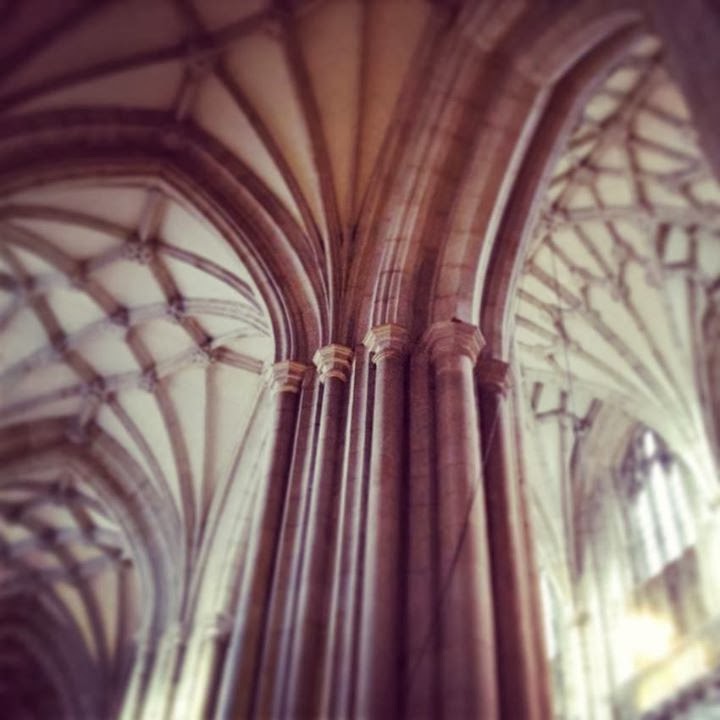
Winchester Cathedral
 In particular...


The slightly weird thing about visiting Jane Austen's grave is that it's just another slab in the floor which you're clearly not expected to refrain from walking over.  In this photo, you can even see the leg of one of the cathedral chairs placed artistically (or maybe not so artistically) over the gravestone.

Never mind.  Here was the gravestone, and I am thankful that it still exists, unlike so many of the things which used to prove she existed and now are gone forever.  Actually, the more I think about it, the more I think we are extremely lucky to have as much as this grave, because she certainly wasn't drastically famous when she died, and we probably owe our luck to the fact that she had a rich brother.

It wasn't until later that they installed a stained glass window for her in the same cathedral (of which I got no good photos), and this gold thing:


From Winchester, it was off to the tiny town of Chawton, where Jane Austen lived for the last eight years of her life.  This house was a part of her rich brother's estate - he had been adopted by his aunt and uncle when he was small, as they could have no children of their own, and his own parents recognised it was a good opportunity for him.  In fact, his riches meant that Jane, her sister Cassandra and her mother did not have to have a drastic lifestyle change after the death of her father.

The Austen women and a family friend, also a single woman, lived in this red brick house in Chawton:


Jane used to sit in the parlour, writing at this very table, and hiding her sheets of paper under a blotter when people entered for visits:


This was the place she edited Pride and Prejudice, Sense and Sensibility and Northanger Abbey before they were published.  This was the place she wrote Emma, Mansfield Park and Persuasion.

She and Cassandra shared a room upstairs, looking out over the back of the house:


It was absolutely lovely to visit this place.  They had a few items of real interest, like the writing desk, although most items were objects of a similar kind to what the Austen family might have had in their home.  Walking round someone's house, though, you get a sense of the way they lived, and can visualise their lifestyle in a new and interesting way...  I found it quite moving and I also found myself thinking extremely conceited thoughts like "We would have been best friends!"  Slightly wishful thinking but that was the direction my thoughts went in.

This really was a wonderful note to finish my time in England on.  (If I were being really honest I would admit that I actually finished my time in England in the nearby town of Basingstoke and then flew out of London Stansted, neither of which is in any way romantic or exciting, but I'm going to pretend I ceased to be in England when I left Chawton.)

Saturday, March 1, 2014

novel or fanfiction?

I should have learnt my lesson last time I hunted down a continuation to Jane Austen's unfinished novel The Watsons.

And then Book Depository recommended this for me... Joan Aiken's 'completion' of Jane Austen's fragment: The Watsons & Emma Watson.  Of course I had to have it.


The last time I tried John Coates' continuation I was disappointed, even though it wasn't a bad book, simply because I loved the original fragment so much that it would be hard for anyone else to satisfactorily complete it.  But I wondered if maybe this would be better.

Unsurprisingly, it wasn't... not really.  Again, it wasn't a bad book.  It was fairly readable.  It was somewhat higher quality than most of the fanfiction I used to obsessively read.

But it certainly wasn't Jane Austen.

It would be asking a lot to expect that.  Nevertheless, it's sad.  I actually think the author here bit off more than she could chew - normally, with fanfiction, you can start a new story, featuring a new perspective, and so the comparison is not so transparent.  In this case, the reader has to read Jane Austen's unfinished text right at the beginning, and the new part needs to seamlessly flow on from that.  It did not.

The main problems:
  • Characterisation - The characters we had already met changed slightly, and subtly modernised.  New characters introduced into the story were pretty two-dimensional.
  • Odd and unnecessary plot twists - Aiken chose to kill off some critical characters - Jane Austen herself indicated to her sister that one character would have died if she had finished the book - but the others, I think, were completely unnecessary, and it just didn't feel like the sort of decision Austen would have made for the plot.
  • How the book ended - The ending raced to its conclusion in an oddly unsatisfying way.  I also think that the author should have paid slightly more attention to Austen's own intentions for the book.  I get that you have to do what works for the story as you actually write it, but the inspiration for this book did not belong to Joan Aiken, and yet she chose to send the book in a different direction than Austen said she would have.
  • Period detail overkill - The author was way too keen to include period detail, as if to say, "look, look, I've done my research!"  It was all detail that I can't see Austen getting into - she didn't need to include it because her readers would have understood.  I guess your opinion on this might differ based on your expectations of the book - I expected to see a "completion" of Jane Austen's manuscript, not a new book directed at modern readers.

Having said all that... the book's not bad.  It's a pretty good effort at fanfiction, in my opinion, as fanfiction attempts go.  But it's quite a big claim to make - that you are "completing" a Jane Austen novel - and I'm afraid I was consequently slightly more judgmental than I might otherwise have been.  Two stars from me.

Saturday, February 22, 2014

what I did on my holidays (part the second)

Bristol
After visiting Bath, I had a non-Austen interlude in Bristol, visiting my old penpal and former fellow HDtS editor V. - which was lovely.  The last time we saw each other we were 11 years old!

Somewhere in Somerset

After two nights with V. and her husband M., I hired a little red ladybug-like car and set off on the next stage of my literary pilgrimage.  To be honest, the first stage of this next stage was not-so-literary - I was simply driving through Somerset, on the way to my ultimate literary destination, and stopping at Wells to see a pretty cathedral town.  And a pretty cathedral town it was:

Wells
After wandering round Wells and scoffing a Cornish pasty, I was on the move again - driving into Dorset on my way to the coastal town of Lyme Regis.

Lyme Regis
Lyme Regis is a gorgeous little seaside town on the Jurassic Coast of southern England, and it happens to be a place where the Austen family spent some holidays.  Jane Austen loved the place, and she ended up using it for the location of a pivotal part of Persuasion.  (Interestingly enough, I understand it's also the location for a Meryl Streep movie, the title of which I cannot remember...)


Even if I weren't a Jane Austen fan, I would have loved visiting this place.  Little English seaside towns have such an atmosphere, and this one is completely charming.

But it certainly added something, knowing that I was walking around a place that Jane Austen loved, and, especially as I approached the Cobb, visualising her characters taking the very same path as me.

The Cobb


The Cobb is a kind of breakwater to the west of the village which creates an artificial harbour - boats can be moored within it while the waves beat on the other side.  I had no idea until now just how old it is - the first written record is from 1328.

You can walk along the top, and risk getting splashed, or down out of the wind and seaspray.  I walked on the top, and I can understand now exactly why Louisa Musgrove started getting over-excited.


... as they drew near the Cobb, there was such a general wish to walk along it once more, all were so inclined, and Louisa soon grew so determined, that the difference of a quarter of an hour, it was found, would be no difference at all; so with all the kind leave-taking, and all the kind interchange of invitations and promises which may be imagined, they parted from Captain and Mrs. Harville at their own door, and still accompanied by Captain Benwick, who seemed to cling to them to the last, proceeded to make the proper adieus to the Cobb. ...

The steps of the Cobb
There was too much wind to make the high part of the new Cobb pleasant for the ladies, and they agreed to get down the steps to the lower, and all were contented to pass quietly and carefully down the steep flight, excepting Louisa: she must be jumped down them by Captain Wentworth. In all their walks he had had to jump her from the stiles; the sensation was delightful to her. The hardness of the pavement for her feet made him less willing upon the present occasion; he did it, however. She was safely down, and instantly to shew her enjoyment, ran up the steps to be jumped down again. He advised her against it, thought the jar too great; but no, he reasoned and talked in vain, she smiled and said, "I am determined I will": he put out his hands; she was too precipitate by half a second, she fell on the pavement on the Lower Cobb, and was taken up lifeless! There was no wound, no blood, no visible bruise; but her eyes were closed, she breathed not, her face was like death. The horror of that moment to all who stood around!

Captain Wentworth, who had caught her up, knelt with her in his arms, looking on her with a face as pallid as her own, in an agony of silence. "She is dead! she is dead!" screamed Mary, catching hold of her husband, and contributing with his own horror to make him immoveable; and in another moment, Henrietta, sinking under the conviction, lost her senses too, and would have fallen on the steps, but for Captain Benwick and Anne, who caught and supported her between them.

"Is there no one to help me?" were the first words which burst from Captain Wentworth, in a tone of despair, and as if all his own strength were gone. 

"Go to him, go to him," cried Anne, "for heaven's sake go to him. I can support her myself. Leave me, and go to him. Rub her hands, rub her temples; here are salts: take them, take them."

Captain Benwick obeyed, and Charles at the same moment disengaging himself from his wife, they were both with him; and Louisa was raised up and supported more firmly between them, and everything was done that Anne had prompted, but in vain; while Captain Wentworth, staggering against the wall for his support, exclaimed in the bitterest agony --
   
"Oh God! her father and mother!"
   
"A surgeon!" said Anne.


I couldn't stop smiling as I walked up and down the Cobb and particularly as I carefully made my way down the steps.  This is my happy place.

And that was the end of the second day of my pilgrimage.

Sort of.  I then drove to a tiny little place called Durweston, Blandford Forum, Dorset - which I think is just a wonderful series of names - and stayed the night in a thatched cottage.  I would name this day as one of the best days of my whole trip.

Thursday, February 13, 2014

what I did on my holidays (part the first)

Pulteney Bridge


I did a lot of things on my holidays.  They were six weeks long and I visited Europe, in fact.  But one of my favourite things of all was my Jane Austen pilgrimage.

Part 1 of the pilgrimage was in Bath, England, where Jane Austen spent some years of her life and where parts of her novels Northanger Abbey and Persuasion are set.  It happens to be somewhere she hated to live - it is said that she fainted when she learned that her parents were leaving the family parsonage in Steventon, Hampshire, and taking Jane and her sister Cassandra to live in Bath.  When she wrote Northanger Abbey as a younger woman the bright lights were still an exciting prospect for her, but by the time she wrote Persuasion as an older woman she had well and truly tired of Bath and what I understand she considered to be its shallowness.  While she lived there, she found herself unable to write successfully at all.  It was not until she left Bath and moved to the small village of Chawton, onto her brother's estate, that her most productive era began.

There is a bit of a Jane Austen industry in Bath - it is home to the Jane Austen Centre, and its heyday was Georgian, so it really does look the part.  I even found a free audio tour online, with a complementary map, to take you around "Jane Austen's Bath".  In fact, it's a collection of places that are directly relevant to Jane Austen and her novels, and then a bundle of other places that just look like Regency fiction (or may have been scenes in different movie adaptations).

Having said that, despite all the Georgian England overtones, I wandered into a random café at one point, sat down and realised I was sitting next to a Rolling Stone (Ronnie Wood, to be precise, looking slightly out of place).  Luckily, at 27 years old, I'm not young enough to interest him, but for those out there who may not be fans of Jane Austen, there are other reasons to visit Bath.

Anyway - back to the tour - I will take you through a few of its moments.

The Pump Room
First up, the Pump Room.  I have to admit I only popped my head in here because it was a particularly beautiful tearoom/café (maitre d', live pianist, crisp linen and all that) and I didn't feel like paying to eat more food and having to mind my manners instead of pulling my book out and leaning on my elbows on the table.  But while I hovered at the entrance, I took a deep breath, assessed the room, blotted out all the modern-day tourists and elderly couples drinking tea and eating scones - and imagined women in Empire-waisted dresses - circulating.  It was a successful imagining.

Laura Place
I got quite excited when I arrived at Laura Place - a square which was very desirable in early 19th century England - and which I imagine is probably still pretty desirable today.  "Our cousins the Dalrymples" lived there: that is, the Dowager Viscountess Dalrymple and the Honourable Miss Carteret of Persuasion, the noble, rich but meaningless cousins courted by Anne Elliot's father and sister.

Jane Austen's noble residence
Soon after walking a little further down Great Pulteney Street, I turned onto Sydney Place, which is a little more plebeian than Laura Place and Great Pulteney Street, and happens to be where Jane Austen resided while in Bath - until her father sadly died, and her family could no longer afford to live there.

Like any great site in Europe, it was covered in scaffolding.  (I can only assume it is due to its greatness and to my tendency for bad luck?)
Royal Crescent
Royal Crescent bears no real connection with Jane Austen except that it is a very lovely and reasonably regal-looking street which appears in a number of Austen adaptations for the screen.  I'm okay with that - it was definitely worth seeing.

Shortly before arriving at Royal Crescent, I walked down:

Gravel Walk
'Gravel Walk.'  As I walked I listened to the audioguide, and this is where I really felt the audio was a great idea.  It was quite an experience to listen to the following as I walked - the happy reconciliation  of two loved, deserving characters in my favourite book:

Soon words enough had passed between them to decide their direction towards the comparatively quiet and retired gravel walk, where the power of conversation would make the present hour a blessing indeed, and prepare for it all the immortality which the happiest recollections of their own future lives could bestow. There they exchanged again those feelings and those promises which had once before seemed to secure everything, but which had been followed by so many, many years of division and estrangement. There they returned again into the past, more exquisitely happy, perhaps, in their reunion, than when it had been first projected; more tender, more tried, more fixed in a knowledge of each other's character, truth, and attachment; more equal to act, more justified in acting. And there, as they slowly paced the gradual ascent, heedless of every group around them, seeing neither sauntering politicians, bustling house-keepers, flirting girls, nor nurserymaids and children, they could indulge in those retrospections and acknowledgments, and especially in those explanations of what had directly preceded the present moment, which were so poignant and so ceaseless in interest. All the little variations of the last week were gone through; and of yesterday and to-day there could scarcely be an end.

Gravel Walk must be a very different place than it was then, but it's still there, and it was a lovely feeling to me to know that Jane Austen had wandered along the same walk, and sent her own characters there for such a moment in their lives.

Disappointments:
  • The Jane Austen Centre - It's really set up for people who just looooove Mr Darcy and his wet shirt.  I'm not knocking the shirt.  I just wanted to learn something.  I did, however, buy a cool graphic novel version of Pride and Prejudice in the shop.
  • The Assembly Rooms - They were closed for a function.  Whaaaat?!  I had been really looking forward to wandering around pretending to be Catherine Morland.

Sunday, January 27, 2013

evelina


I have just finished reading Fanny Burney's Evelina for the first time, and I found it highly enjoyable.  One of my new year's resolutions this year was only to read really good or really fun books, and this was not a bad place to start.

I struggled a little bit with Evelina's extreme delicacy and tendency to confusion, swooning, inability to act like a normal person in public, etc.  I was more than a little frustrated at her constant sense of duty to everyone else's opinion, and then the fact that she would blame herself when what they said turned out to be a bad idea.  The setting was one where every woman is an angel or a harlot, where intelligence in a woman is viewed with extreme suspicion, where the good characters all seem to be a little bit dull and the bad characters are roundly condemned but much more interesting, although the author doesn't appear to realise this.  I struggled with it, but I enjoyed it as an interesting historical experience.  It was a lesson in appreciating the feminist movement and the changes of the last couple of centuries, and I enjoyed it as a novel, a rollicking read.  This blogger puts it well:

Somehow, it did not bother me as I would have expected. Yes, I wanted to thoroughly shake Evelina every once in a while, tell her to open her eyes and not be so gullible. And oh yes, I even considered slapping her. But all in all, I could not help but be entertained.

As the blogger points out, quoting an introduction written by Edward Bloom, this novel is at least an improvement on a familiar theme:

“In this kind of feminocentric novel, the transition from innocence to experience is conceived not as a fall, but as a narrative of progress and understanding.”

So at least it allows Evelina her (slight) growth as a character without lamenting a loss of womanhood.

It was also a really excellent experience to read something that was in Jane Austen's school of novel-writing, and to really see how wonderfully different Austen's female characters are.  I've always liked them for their independent, clever streak, but I don't think I'd realised how unusual that was for her day and age.

Which leads me to another point - I suppose I have learned satire from Jane Austen, because I struggle with the label of 'satire' being placed on this book.  Yes, it is apparently satirical.  Maybe I am misunderstanding the word somewhat?

Yes, there are a number of characters that appear rather ridiculous, but we see them all from Evelina's rather insipid (though very nice) point of view and so the book seemed to me more Moralistic than Satirical.

But then again I seem to be in disagreement with a number of people - according to this blogger, Evelina is a 'ruthless' character:

Evelina is described throughout the novel by many characters as being innocent, but in fact she is anything but. She is, indeed, quite coldblooded in using her both her femininity and her youth to her advantage to achieve her aims. Evelina is a manipulative young lady who routinely censors what others say when relaying the meaning she wishes to convey.

I really don't see it.  Another blogger doesn't see it:

Evelina the character is boring. She’s passive, she’s perfect, she’s dutiful, she’s self-effacing. She doesn’t seem to have a mind of her own. Her story at the end of the novel is entirely predictable.

This other blogger writes, on a slightly different tack, with a slightly more complex impression:

The story of Evelina is the story of a young girl learning her place in society and grappling with keeping her identity while attempting to fit into the culture of the time.  ... Evelina attempts to con-temporize her self-image while attempting to belong in society. The forces of social convention weigh so heavily upon her, Evelina thinks “…there ought to be a book, of all the laws and customs a-la-mode, presented to all young people, upon their first introduction into public company” (Burney XX: 84). This statement shows the character’s desire to conform to social convention and alter her self-image so as to belong in the crowd. The willingness of the main character to change herself, rather than have people accept her for her faults, shows that the author thinks the force of social convention is stronger than that of free will.

It was really interesting to me to see how different an impression different people have taken from this novel.  If that's possible, maybe my first reading was not so discriminating.  Maybe it is possible to read it in a whole myriad of ways.  I'm sceptical... but I will read it again one day, and maybe I will see something more.

Tuesday, July 24, 2012

becoming jane


Because I am a glutton for punishment, I read the fragment of Jane Austen's unfinished novel The Watsons again, about a month ago. I knew I shouldn't have done it. It was devastating to get to the end of the few chapters and have to stop - it wasn't perfected, but it was so promising, and I am so sad that she decided not to finish it!

It was bugging me all day, and I ended up googling. I know it's silly, but I thought there was the slightest chance that SOMEONE, somewhere, might have written an ending to the novel that wasn't terrible, and if they had, I was going to read it. Austen had told someone - I think her sister - a few things about what would have happened in the novel, had she finished it, and so I hoped that this might mean that the story wouldn't be ruined completely.

I found a reference to this book pictured above on a blog somewhere - it's out of print and rather hard to get hold of - a continuation of The Watsons, written by a John Coates in 1958. I was lucky enough to find a very cheap copy on a website somewhere, and thought 'what have I got to lose?'

I must admit that when the book arrived in the post a couple of weeks ago I started to worry. What if it was terrible, and it ruined the fragment for me? The blurb on the back cover certainly didn't allay any fears. However, I used this weekend to read the book, and fortunately it wasn't a bad way to spend the weekend!

Now - Mr Coates is certainly no Miss Austen. Reading this book was actually an interesting exercise for me because it brought out Austen's skills that cannot be copied. The tightness of her plots is never something I've paid particular attention to before, but this plot was far too circuitous and made me recognise how skilfully she winds up and unravels her stories. The characterisations, needless to say, were lacking. It wasn't as funny, although it tried to be.

To be fair, however, this is all in comparison. The book I read over the weekend was enjoyable. There was something of a spark about it. And it somewhat satisfied the hunger I had to find out what would become of the Miss Emma Watson of Jane Austen's fragment. I was glad to have read it, and I may even read it again someday. It was like reading a really good piece of fanfiction. I commend Mr Coates for the attempt - he is a brave man - and I think I would recommend his continuation to someone who is suffering from the same sorrow as I after reading the fragment.

My advice, therefore: Lower your expectations if you decide to read this book, and then you'll be pleasantly surprised. If your expectations are too high you may find it difficult.

Three stars from me.

Monday, October 10, 2011

quotable

What I learned from authors, part I


I've been thinking about what I've learned from other authors when it comes to lessons for my own writing.

To start off, and inspired by my friend and former flatmate, Jessica, who has written and illustrated her own children's book, I bring you a blog post with some actual quotable quotes about writing, by writers, which have been thought-provoking for me.

A writer is someone on whom nothing is lost. - Henry James
This is one of the few quotes about writing in which I first saw myself. It was an encouraging moment, to realise why I write and to understand that it's not necessarily normal to notice as much as I notice.

Often, I think writing is a sheer paring away of oneself, leaving always something thinner, barer, more meagre. - F. Scott Fitzgerald
Well, I certainly felt this way after my finishing my thesis, although I suspect that I would invest even more of myself in a novel.

Human language is like the cracked kettle on which we beat out tunes for bears to dance to, when all the time we are longing to move the stars to pity. - Gustave Flaubert
There's something ironic about this quote, in that it's written so beautifully even as it mourns for the absence of a completely satisfying language. I like that. One has to remember that although perfection is so far from one's grasp, it is still possible to write magically.

There is nothing to writing. All you do is sit down at a typewriter and open a vein. - Red Smith
Reading this was one of the first times I realised that my vision of becoming an author was not a very romantic vision.

I... do not think the worse of him for having a brain so very different from mine. ... And he deserves better treatment than to be obliged to read any more of my works. - Jane Austen
At first when reading this I thought of V. S. Naipaul and his comments about women writers, and I thought about how comparatively gracious Jane Austen was in this sense. Then I also learned an important lesson - not everybody needs to like your writing.

I was working on the proof of one of my poems all morning, and took out a comma. In the afternoon I put it back again. - Oscar Wilde
OK, so I haven't quite got this far yet, but I certainly empathise and can see this in my future!

A man's got to take a lot of punishment to write a really funny book. - Ernest Hemingway
Verification from one of the "great writers" that the literature that is not usually seen as "high" can be the most difficult to write.

And now for a quote I disagree with:
Writing is a cop-out. An excuse to live perpetually in fantasy land, where you can create, direct, and watch the products of your own head. Very selfish. - Monica Dickens
Now, I don't like this quote so much, because I think that writers are perpetually bound to reality, even the writers that produce fantasy or science fiction or the like. Writing is hard work and then on top of that the "real world" is constantly standing over you, hammering you with its reality cudgel until you bleed, trying to make your writing work.

What have you learned from the advice that other authors have given?

Saturday, June 4, 2011

some thoughts on V. S. Naipaul, female writers and Jane Austen

So, the latest mudslinging match in the literary world: V. S. Naipaul's comments about himself, about women who write, about his former editor Diana Athill, and about Jane Austen.

(Naipaul won the Nobel Prize for Literature in 2001. He has written books like A House for Mr Biswas. I have not read any of his books so I will not be commenting on his literary talent. I understand he is a skillful writer with an off-putting personal life.)

The Guardian's summary
is pretty good, but for your information, here are some of the things he said:

- No woman writer is his equal, in literary value or skill.

- People like his former editor, a successful writer in her own right, and Jane Austen are good examples of a "feminine" style which he labelled "feminine tosh". He can always pick up a piece of writing and assess within a few minutes whether it was written by a man or a woman.

- Jane Austen in particular wrote books out of "sentimental ambitions" and had a "sentimental sense of the world".

- This is because women inevitably are not "complete master[s] of a house", and so they have a "narrow view of the world".

I think my first response to these comments was confusion - I felt like laughing uproariously but I also felt rather horrified.

Here are some of my bullet-pointed thoughts in response.

1. Jane Austen? Sentimental?!
Have we been reading the same novels?
If you're going to pick an example of a sentimental female writer, surely Austen is one of the most bizarre choices to pull out of one's hat.

2. My theory is that he secretly identifies with Jane Austen's most ridiculous characters. The vain Sir Walter Elliot, the pompous Mr Collins. It's clear to me from this brief encounter with V. S. Naipaul that Jane Austen would have had a field day with him. She would have skewered him. And so he feels threatened.

3. Naipaul's blatant sexism is disturbing, to say the least. I suppose it's not surprising from an unsavoury misogynist who beat his wife, but, as Diana Abu-Jaber writes, his comment about women failing to be "master" of their own homes is chilling.
It is also horridly ironic, coming from someone who criticises women who fail to write about the evils of Western colonialism, but who does not notice his own ruthless male colonialism of the home.

4. Naipaul is so absorbed in himself that he clearly values no literature except his own genre and only a few within his genre. As Roxana Robinson said:
I suspect that, actually, Naipaul doesn’t think any male writers are his equal, either, nor any Jewish writers, nor Chinese or Arabic ones. I think Naipaul thinks no-one is his equal, and, in terms of hubris, he may be right.
It is, in fact, tempting to ignore him entirely. Except that I feel so furious.

Here is some more comment:
Diana Athill on Naipaul's attack on her
The Guardian's test: can you tell if the author is male or female?
"Sense and Sentimentality"
Jennifer Egan's response
The response of the Tribune (India)

I leave you with a quote from Jane Austen's Sense and Sensibility. The author is dead, but she still manages to speak for herself:

She agreed to it all for she did not think he deserved the compliment of rational opposition.

Thursday, April 28, 2011

listening in to Emma Woodhouse

A little while ago, I bought a cheap audiobook of Jane Austen's Emma on iTunes. And then, this week, I happened to be doing a lot of painstaking, long-lasting but completely mindless activities - knitting a scarf, painting decorations for my upcoming singalong Chitty Chitty Bang Bang party, lots of baking, going for walks, etc. It seemed like perfect timing to pull out an audiobook and listen as I worked.

I make it a point not to read Jane Austen novels too often because I love them so much and get such a pure enjoyment out of them that I don't want to risk becoming used to them. So it's actually been quite a long time since I read Emma, and I've only read it about twice, maybe three times at most. And I found myself rediscovering the book with great pleasure.

I really think it's such a wonderfully-structured novel. It's one of those novels which is very exciting as you read it for the first time, because the plot unfolds with so many little and large surprises. However, I discovered that it's just as wonderful to read a second time - Austen has packed it full of little road signs and ironies that all point towards the ultimate denouement, and these are so enjoyable to pick up on that knowing what is about to happen becomes a positive thing! I also love the skill with which Austen gives us a hidden love story, a love story in the background which is unseen by all the characters and all first-time readers but which becomes clear after the first reading. It is rather a touching love story.

Reading Emma this time around, I think I may have matured a little, because I found Austen's portrayal of Miss Woodhouse very satisfying. Last time, I was probably disappointed by the lasting imperfections of her character. This time, I loved how the narrator is so unreliable, and how Emma is so flawed, and how the narrator never judges Emma. She simply lays out this character who is as charming and well-meaning as she is mischievous/prideful/arrogant. She gives us a character who is lovable despite her faults and even because of her faults. Even towards the end, Austen doesn't fall prey to the temptation to completely rehabilitate her main character. The novel is a journey of self-discovery, and yet it's not over at the end, and she's still not perfect. There's a delicious irony to the fact that Emma feels so exposed to herself and yet there is still so much she is unaware of.

This is characterisation that precludes academic mangling. It resists a Marxist reading, a feminist reading, and many other kinds of readings - it's much more complicated.

Of course, we are given all the wonderful minor characters, a hallmark of Austen novels. Mrs Elton is deliciously awful. Miss Bates is so lovely and yet so painfully familiar to all of us. Mr Woodhouse such a nice, narrow-minded old invalid.

It is rather a long book. Reading it as an audiobook helped a little because I could not skim the longest episodes but had to listen to the whole - and this was definitely worth doing. I loved it. I feel a little sad at the prospect of doing mindless tasks without Jane Austen, now. Four and a half stars. No surprise, given my love for Austen, but I am trying to be unbiased and objective!!