Monday, January 9, 2012

literature's biggest fan

I came across this epitaph to literature in an article in one of my favourite magazines, composed by my nation's Prime Minister for a 'literature heritage trail':

I have always believed we should enhance the literary skills of our young people and while our literary heroes may never challenge the glory and respect given to our All Blacks, we still need role models to inspire us.

This Literary Heritage Trail celebrates writers, poets and playwrights who have contributed to this young country’s cultural and historical life.

I hope you will take the opportunity to be part of this journey.

- Hon. John Key, Prime Minister of New Zealand.

What an overture to literature! What a resounding tribute! You'll never quite make it to the heady heights of kicking a ball around a field, writers - but cheer yourself on the hope that maybe you can be ... a role model?

Honestly?

I don't think I've ever thought of the great authors as role models - have you? Actually, I'm not sure I'd want any of my kids to view them in that light. "Maybe someday I can be a great writer, Mummy, and smoke too much, notice everything that's wrong with society, behave unsociably, feel overwhelmed by my failures and probably fail to gain recognition until I'm dead!"

Sometimes, people should just not try very hard to talk up something they're obviously not very interested in. Let that be a lesson to you, John Key.

Saturday, October 22, 2011

the big sleep


I am going to fall far short of reviewing Raymond Chandler's The Big Sleep appropriately. I simply can't bring myself to even attempt to describe it in its own terms. It's probably better that I don't try. Here is your review, written by a middle-class New Zealand ex-English literature student who has finished everything Agatha Christie or Ngaio Marsh ever wrote and so needed some new crime fiction addiction - and got something worlds apart from Miss Marple.

I saw the Bogart film a few years ago - liked it but can hardly remember what happened, which was good in terms of reading the novel with an open mind.

As far as the novel goes, I wondered as I started if I would be able to keep going. It's written very simply and in a matter of fact manner which is difficult to get accustomed to:
I went over to the mail slot and picked up six envelopes, two letters and four pieces of advertising matter. I hung my hat on the telephone and sat down.
But then there are all the crazy similes and personification and turns of phrase, the proliferation of guns and gutter-dwellers, the underbelly of society presented on the page, and it gets interesting:
She approached me with enough sex appeal to stampede a businessman's lunch.

The air was thick, wet, steamy and larded with the cloying smell of tropical orchids in bloom. ... They smelled as overpowering as boiling alcohol under a blanket.


The calves were beautiful, the ankles long and slim and with enough melodic line for a tone poem.

She gave me one of those smiles the lips have forgotten before they reach the eyes.

Brody's dark brown stare moved up and down my face. His Colt went on hungering for my vital organs.

... against a scribbled wall a pouch of ringed rubber had fallen and not been disturbed.

"Eddie Mars had Regan bumped off," he said calmly, and leaned back as if he had just been made a vice-president.

The purring voice had an edge, like sand in the bearings.

"You'll tell me, little man. Here, or in the back room where the boys pitch dimes against the wall."
Then there's the private detective/street talk which much of the time was incomprehensible to me but worked all the same:
"Agnes is a nice girl. You can't hold that stuff on her. It's not so easy for a dame to get by these days."
"She's too big for you," I said. "She'll roll on you and smother you."
"That's kind of a dirty crack, brother," he said with something that was near enough to dignity to make me stare at him.
I said: "You're right. I've been meeting the wrong kind of people lately. Let's cut out the gabble and get down to cases. What have you got for the money?"
Did people ever actually talk like this? I almost hope so.

What bugged me about this novel, however, was Chandler's treatment both of homosexuals and women. I'm sure this is not an original complaint to make, because it's so pronounced a quality of this book. It kind of reminded me of Ian Fleming's treatment of women.
You can have a hangover from other things than alcohol. I had one from women. Women made me sick.
Well, excuse me, Mr Chandler, none of the men in your novel are glittering testimonies to mankind either. And don't even get me started on your repulsive characterisation of the homosexual kid.

It doesn't really have a strong plot, either, and was a little confusing to follow. Especially as it's difficult to understand what the heck the characters are talking about.

I can't deny this, though: the book is fun. I'm not sorry to have read it. There was something deliciously sordid about it. It deserves at least three stars.

Tuesday, October 18, 2011

EEC

I've linked to Jen Campbell (otherwise known as aeroplanegirl on twitter) and her blog many times now. Among other things, she brought us the hilarious "Weird Things Customers Say in Bookshops" series, which is soon to be published as a book.

Jen has a condition called EEC Syndrome, which causes gradual blindness in those affected by it. You can read about her experience of it here. She is fundraising for research into degenerative eye conditions in a very cool way - writing 100 poems over the course of one weekend in November - and you can sponsor her at this link.

This is a cause that could radically change the lives of many many people, but it's hardly well-known, or sexy, as charitable causes go. Why not support research in a new and interesting way and support Jen's poetry with as small or large a donation as you can muster?

Monday, October 10, 2011

quotable

What I learned from authors, part I


I've been thinking about what I've learned from other authors when it comes to lessons for my own writing.

To start off, and inspired by my friend and former flatmate, Jessica, who has written and illustrated her own children's book, I bring you a blog post with some actual quotable quotes about writing, by writers, which have been thought-provoking for me.

A writer is someone on whom nothing is lost. - Henry James
This is one of the few quotes about writing in which I first saw myself. It was an encouraging moment, to realise why I write and to understand that it's not necessarily normal to notice as much as I notice.

Often, I think writing is a sheer paring away of oneself, leaving always something thinner, barer, more meagre. - F. Scott Fitzgerald
Well, I certainly felt this way after my finishing my thesis, although I suspect that I would invest even more of myself in a novel.

Human language is like the cracked kettle on which we beat out tunes for bears to dance to, when all the time we are longing to move the stars to pity. - Gustave Flaubert
There's something ironic about this quote, in that it's written so beautifully even as it mourns for the absence of a completely satisfying language. I like that. One has to remember that although perfection is so far from one's grasp, it is still possible to write magically.

There is nothing to writing. All you do is sit down at a typewriter and open a vein. - Red Smith
Reading this was one of the first times I realised that my vision of becoming an author was not a very romantic vision.

I... do not think the worse of him for having a brain so very different from mine. ... And he deserves better treatment than to be obliged to read any more of my works. - Jane Austen
At first when reading this I thought of V. S. Naipaul and his comments about women writers, and I thought about how comparatively gracious Jane Austen was in this sense. Then I also learned an important lesson - not everybody needs to like your writing.

I was working on the proof of one of my poems all morning, and took out a comma. In the afternoon I put it back again. - Oscar Wilde
OK, so I haven't quite got this far yet, but I certainly empathise and can see this in my future!

A man's got to take a lot of punishment to write a really funny book. - Ernest Hemingway
Verification from one of the "great writers" that the literature that is not usually seen as "high" can be the most difficult to write.

And now for a quote I disagree with:
Writing is a cop-out. An excuse to live perpetually in fantasy land, where you can create, direct, and watch the products of your own head. Very selfish. - Monica Dickens
Now, I don't like this quote so much, because I think that writers are perpetually bound to reality, even the writers that produce fantasy or science fiction or the like. Writing is hard work and then on top of that the "real world" is constantly standing over you, hammering you with its reality cudgel until you bleed, trying to make your writing work.

What have you learned from the advice that other authors have given?

Friday, September 30, 2011

reading paint VIII

some of my favourite works of art with reading in them, which I have not yet shown you

Paul Serusier, 'La Grammaire'
[source]

Vittorio Reggianini, 'The poetry reading'
[source]

Coles Phillips, 'Woman reading a book'
[source]

Attilio Baccani, 'Lady reading a book'
[source]

Budapest statue, 'Anonymous'
I took this photo in Budapest in September 2009.

Phil Winsloe, 'Reading in the chapel'
[source]

Edward Hopper, 'Compartiment C, Voiture 193'
[source]

Sigmund Hampel, title unknown
[source]

Francesco Pige, 'The portrait of Penelope Deligiorghis-Drossini'
[source]

Edward Cucuel, 'The novel'
[source]


Tuesday, September 20, 2011

poetry from a pile of books

This is an idea stolen/borrowed/taken from Jen of This is Not the Six Word Novel. Before that it came from a long list of other people which I won't repeat here but it originated with the writer Tahereh Mafi.

I'm so ridiculously bad at poetry. But this idea was so cool that I ended up doing it anyway. I encourage you to do the same. I'm sure yours will be much better.

My RUSSIAN WINTER

is no WINTER OF FIRE.

OUT OF THE STORM we inhabit

a DARK CONTINENT,

in SUBMISSION to THE BIG SLEEP.

FROM UNDER THE OVERCOAT comes

THE WOMAN IN WHITE.

THAT EYE, THE SKY, looks SOUTH,

but WHEN THE DARKNESS WILL NOT LIFT

I think of THE LAND OF THE GOLDEN APPLE.

I think of SOMEONE ELSE'S GARDEN,

and then TENDER IS THE NIGHT.

Thursday, September 15, 2011

reading paint VII

when reading is all about the position

Pablo Picasso, 'Reclining woman reading'
[source]

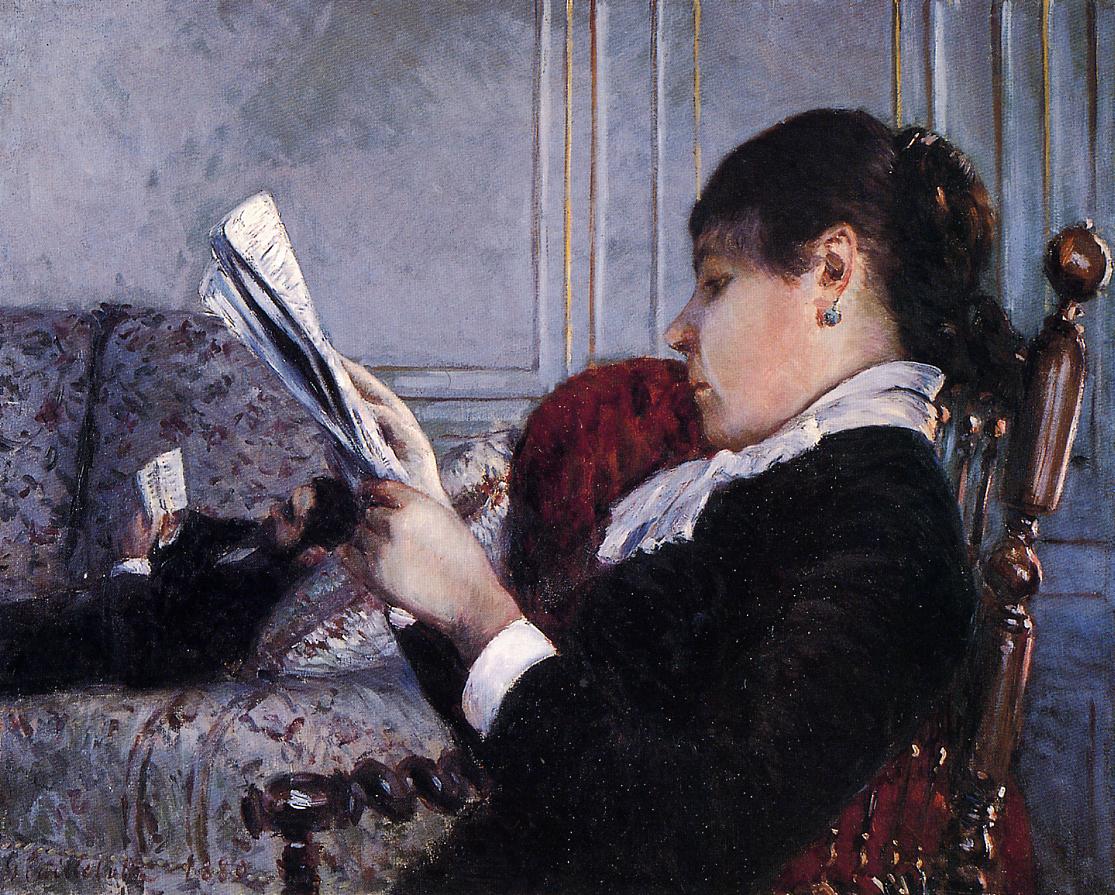
Gustave Caillebotte, 'Interior, Woman Reading'
[source]

Justin Wiest, unknown title
[source]

Balthus, 'The living room'
[source]

Oliver Ray, 'Girl Reading'
[source]

Ye Liu, 'Banned Book'
[source]

Henri Lebasque, 'A Woman Reading'
[source]

Pierre-Auguste Renoir, 'Woman Reading'
[source]

Marie Fox, 'Woman at Beach Reading'
[source]